

Date: Nov 2026
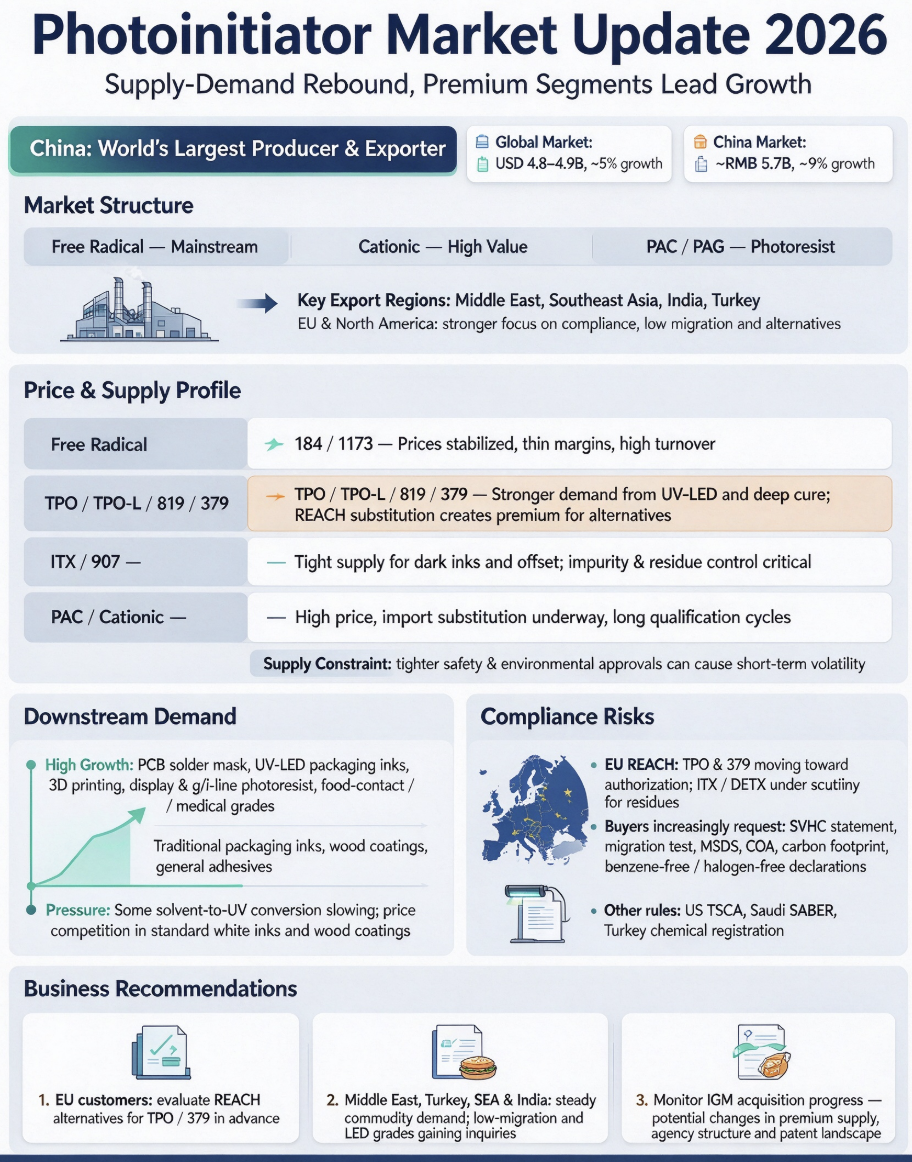
Photoinitiators are core raw materials for UV-curing products including inks, coatings, adhesives, 3D printing materials and photoresists. China is the world’s largest producer and exporter. The industry has emerged from the heavy losses and price wars of 2023–2024. In 2025–2026, supply and demand have picked up, prices have stabilized and rebounded, and market segmentation is prominent: commodity grades compete on thin margins, while high-end specialty products command premium pricing.
Global market size: approximately USD 4.8–4.9 billion in 2026, with an annual growth rate of around 5%. China’s domestic market stands at roughly RMB 5.7 billion, growing at nearly 9%.
Main product categories: free-radical photoinitiators (the dominant segment by volume), cationic photoinitiators, and PAC / photoacid generators dedicated to photoresists (highest added value).
Export profile: conventional grades such as 184, 1173, TPO and 907 are shipped in large volumes to the Middle East, Southeast Asia, India and Turkey. Customers in the EU and North America are placing increasing emphasis on regulatory compliance, low migration performance and alternative grades.
Prices & Supply-Demand Dynamics (2026)
● General grades (184, 1173): Prices have bottomed out and are no longer falling sharply, yet gross margins remain slim; these are high-turnover products. Costs are mainly driven by upstream raw materials, environmental compliance and power expenses.
● TPO / TPO-L / 819 / 379: These grades show stronger market performance. Demand is boosted by UV-LED and deep-cure ink applications. Meanwhile, TPO and 379 are moving through the authorisation process under EU REACH, forcing European customers to switch to modified alternatives such as TMO. Traditional grades face restrictions in Europe and America, and alternatives carry higher premiums.
● ITX, 907: Widely used for dark inks and offset printing. Supply is relatively tight, and control over impurities and residues is a key audit focus for overseas buyers.
● Photoresist PAC and cationic photoinitiators: Priced far higher than standard grades. Local import substitution is underway, offering strong upside for price increases, though customer qualification cycles are lengthy.
Supply constraints: Approvals for new domestic production capacity are stringent with raised safety and environmental standards. Many small manufacturers cannot expand even if they intend to, due to licensing barriers. Shutdowns for maintenance or safety incidents at major producers can easily trigger short-term price spikes.
Downstream Demand by Growth Profile
High-growth segments
● PCB: Solder mask inks for AI servers and high-layer boards continuously drive demand for electronic-grade photoinitiators.
● UV-LED curing: Digital packaging inks, furniture coatings and 3D printing fuel demand for long-wavelength, low-migration and low-yellowing grades.
● PAC for display panels and semiconductor g/i-line photoresists.
● Dental, medical and food-contact grades (meeting FDA and EU 10/2011 requirements), with strict limits on migration and extraction.
Stable segments: Traditional packaging printing inks, wood coatings and general adhesives. Volumes are steady but competition is intense.
Under pressure: The dividend from converting conventional solvent-based systems to UV is fading. Price competition in standard white inks and wood coatings passes pressure upstream.
Compliance Risks (Critical for Foreign Trade)
EU REACH represents the biggest variable: TPO and 379 are advancing through the authorisation pipeline and will face restrictions in the EU in future, pushing customers to source alternatives. Residual impurities of ITX and DETX are closely regulated, especially in food-contact applications.
Overseas buyers increasingly request SVHC statements, migration test reports, MSDS, COA, carbon footprint documentation, benzene-free and halogen-free declarations. Regulatory requirements for photoinitiators are also tightening under US TSCA, Saudi SABER and Turkey’s chemical registration scheme.
Technology Trends
● UV-LED compatible grades: Long-wavelength photoinitiators tuned for 365/385/405 nm are among the most frequently enquired products and a core R&D priority for leading manufacturers.
● Low-migration, macromolecular and low-odour grades: Essential for food packaging and children’s articles, with noticeable premium potential.
● Cationic systems: Suitable for thick films, dark substrates and heat-sensitive materials. Domestic capacity is limited and import reliance remains high.
● Photoresist-specific PAC: Domestic breakthroughs have only recently been achieved. Long-term market potential is substantial, yet qualification cycles run in years.
● Bio-friendly, low-sensitisation new products: Targeted at medical and bio-encapsulation, still in the early development stage.
Post time: Nov-16-2026


