

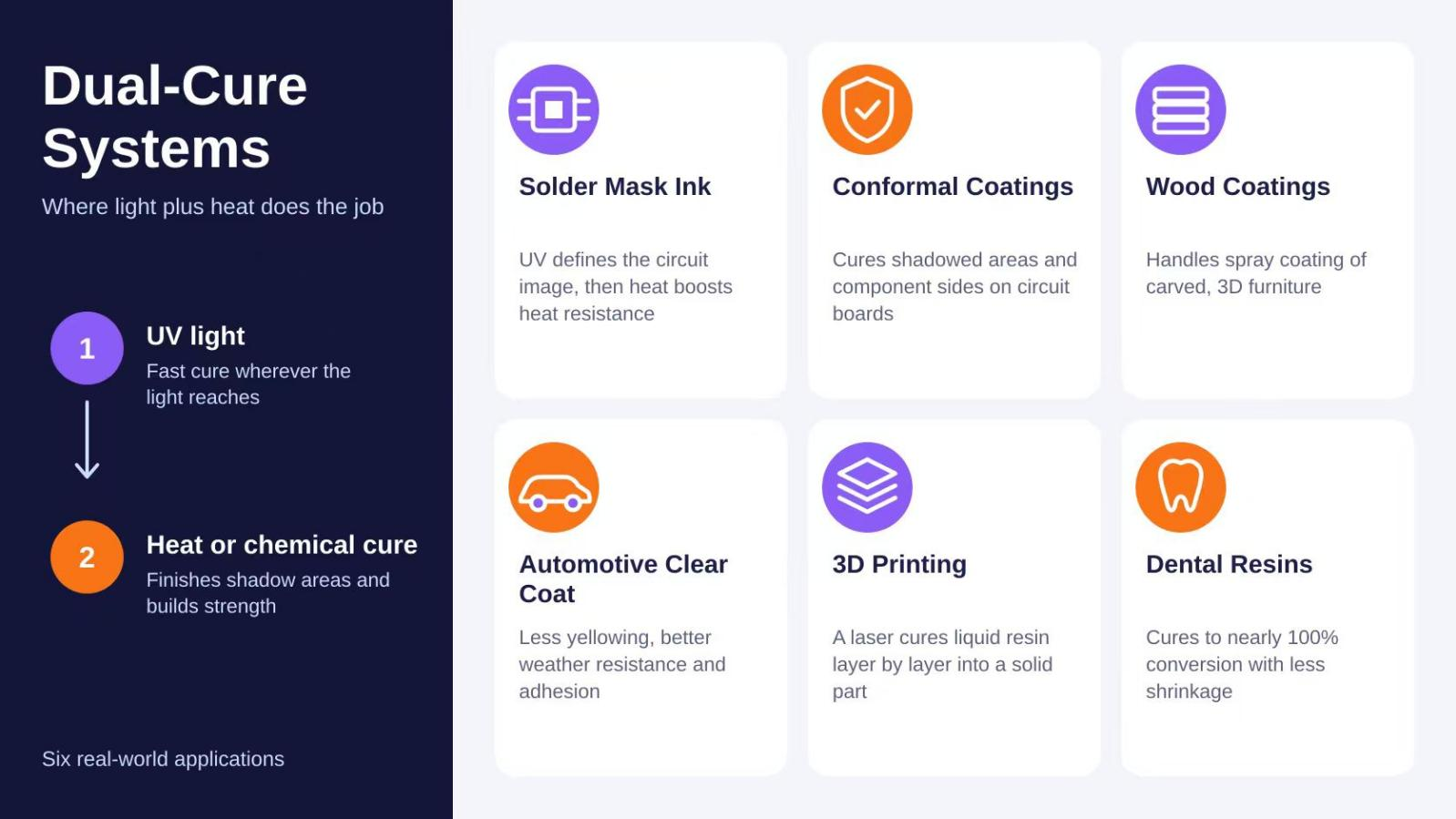
Dual-cure systems are already used in practice. Photoimageable solder mask inks for printed circuit boards, conformal coatings for the three-proofing (moisture, mold, and salt-spray protection) of printed boards, UV coatings for wooden ware and furniture, resins and adhesives for dental repair, and resins for rapid prototyping all use dual-cure systems.
(1) Photoimageable solder mask ink
The main resin of photoimageable solder mask ink is an alkali-soluble photosensitive resin containing carboxyl groups, blended with a small amount of thermosetting epoxy resin. After UV exposure, the resin in the exposed areas crosslinks and cures, and it does not dissolve in dilute alkaline water. The resin in the unexposed areas dissolves in dilute alkaline water, forming the required image. Finally, a thermal cure (140–150 °C × 30 min) causes further thermal crosslinking of the ink, improving the heat resistance and other properties of the ink layer.
(2) Conformal coatings
A conformal coating is a protective coating applied to printed circuit boards that already have soldered components. It protects electronic devices from harmful external environments, such as corrosion from dust, moisture, chemicals, and mold. It provides waterproof, moisture-proof, and mold-proof protection, and it also resists scratching and short circuits, which extends the life of electronic components and improves the stability of electronic products. By curing method, conformal coatings include photocuring, thermal curing, moisture curing, air curing, and others. Photocurable conformal coatings have become the first choice for conformal coating because of their fast curing speed and high production efficiency; their suitability for heat-sensitive substrates and electronic components; their reduced solvent evaporation and low operating cost; and their low equipment investment and space savings. Conformal coating is applied by spraying onto printed circuit boards with soldered components, so curing the coating on the sides of the components and in shadow areas becomes the key to using photocurable conformal coatings well. Therefore, the photocurable conformal coatings now in use all adopt a dual-cure system. This ensures that the coating over most of the circuit board cures quickly under UV light, and that in the post-cure stage the coating in the small shadow areas and on the sides of the components also cures reliably.
(3) Spray-applied wood coatings
Coating of furniture with spray-applied wood coatings has developed from flat coating of panel furniture to three-dimensional coating of carved furniture, and from roller coating and curtain coating to spraying. To adapt to this change, photocurable wood coatings also use dual-cure systems.
(4) Light/heat dual-cure automotive clear coat
When photocurable coatings are used on car exteriors, they have three fatal drawbacks: with three-dimensional surfaces, shadow areas cannot be cured; they tend to yellow; and their weather resistance is insufficient.
Light/heat dual-cure automotive coatings have now been successfully developed. Dual curing overcomes the insufficient curing of photocurable coatings in shadow areas, because thermal curing completes the cure. Because dual-cure systems use less photoinitiator and use additives such as UV absorbers and hindered amines, the problems of yellowing and insufficient weather resistance are overcome. At the same time, thermal curing relieves the residual stress produced in the film during photocuring, which helps improve adhesion. Dual curing also gives the polymer film an interpenetrating network structure, which significantly improves its mechanical properties. Dual-cure automotive coatings use acrylated polyurethane as the photocurable component, and use polyurethane containing –NCO groups together with acrylic polyol as the thermally curable components. A thermal curing system based on acrylated melamine, or one based on epoxy resin, can also be used.
(5) Stereolithography (rapid prototyping) materials
Stereolithography, also called 3D photolithography, is currently the fastest-developing and most promising method of three-dimensional rapid prototyping. A computer-controlled laser beam scans over the surface of a liquid photocurable resin. The exposed areas cure to form a two-dimensional planar pattern. The pattern is then lowered to expose a fresh liquid resin surface, and scanning and curing are repeated, stacking up layer by layer to form a three-dimensional solid.
(6) Photocurable dental restorative resins
Dental treatment differs from the treatment of ordinary diseases. Besides medication, much of it aims to repair missing tooth structure and fill cavities, which requires special dental restorative materials.
There are three main kinds of dental restorative materials: amalgam, porcelain, and composite resin. Amalgam is now basically banned because the mercury it contains pollutes the environment and is unsafe for the human body. Composite resin has become an indispensable material for repairing tooth defects because it is easy to handle, performs well, offers a wide choice of colors, and forms a strong chemical bond with enamel and dentin. By curing method, composite resins for dental restoration can be divided into chemically cured, photocured, and light-chemical dual-cured types, and the photocured type has developed from UV-cured to visible-light-cured.
Dual-cure systems are used in dental restorative resins in two ways. The first is in dental resins for indirect restoration, in which restorations are made outside the mouth. These are not limited by conditions in the mouth, so a dual-cure method can be used: photocuring first, then thermal curing (or chemical curing). This raises the degree of conversion to nearly 100%, reduces volumetric shrinkage, and improves wear resistance and other mechanical properties. The second is in dental adhesives: the exposed parts can be cured rapidly by direct light exposure, and the parts that light cannot reach are cured by chemical polymerization.
In addition, dual curing has great potential in specialty coatings, adhesives, composite materials, conductive inks, and other fields. As long as suitable materials, curing methods, and process conditions are chosen, photocuring technology can be developed further and extended into more areas of application.
Post time: Nov-20-2026


