

1. Dual-Cure Oligomers
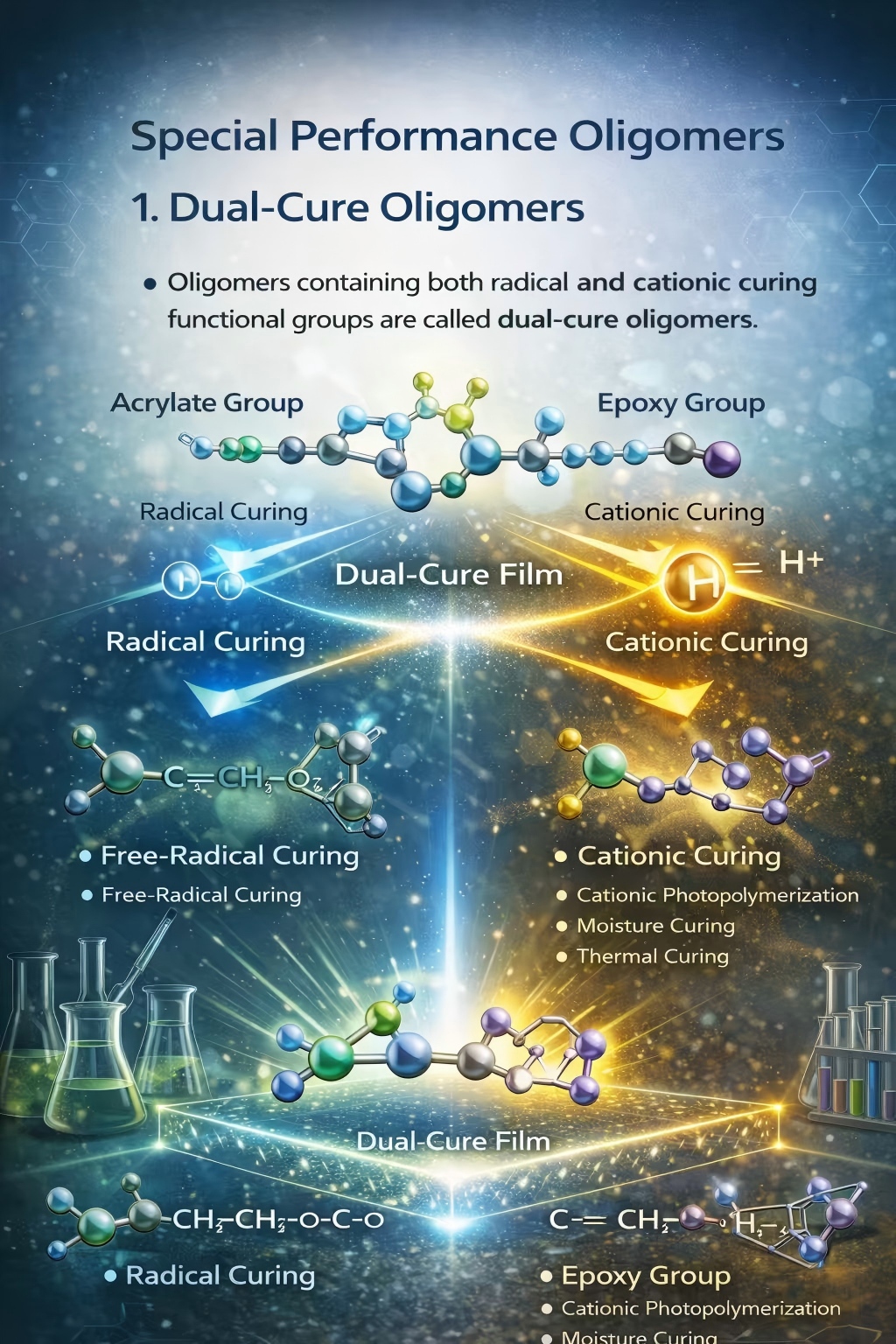
If an oligomer contains two different types of active functional groups for curing, such as an acrylate group that can undergo free-radical curing, and another group that can undergo cationic photocuring, moisture curing, hydroxyl curing, or thermal curing, then it is called a dual-cure oligomer.
Using bisphenol A epoxy resin and acrylic acid in a ring-opening esterification reaction [epoxy group : carboxyl group = (1.5 ~ 2.0) : 1, molar ratio], an epoxy acrylate resin containing epoxy groups is prepared. The acrylic groups can undergo free-radical polymerization, while the epoxy groups can undergo cationic photopolymerization or thermal curing. Research results show that there is an intramolecular interaction between these two active functional groups, which can effectively promote the progress of both free-radical and cationic photopolymerization, significantly improving the reaction rate and final conversion rate, while greatly reducing oxygen inhibition. The cured film formed by dual-cure oligomers exhibits better mechanical properties.
By reacting hexamethylene diisocyanate with N,N-bis(3-aminopropyltriethoxysilane), followed by reaction with hydroxyethyl acrylate, a siloxane-type polyurethane acrylate with both free-radical photocuring and moisture-curing dual-cure properties can be prepared. This can be used in photocurable conformal coatings.
Synthesis of phenolic epoxy acrylate resins containing epoxy groups results in materials with both free-radical photocuring and thermal curing dual-cure functions, which can be used in photoimageable solder resists.
2. Self-Initiating Oligomers
There are two types of oligomers with self-initiating functions:
- The oligomer itself has photoinitiating capability, so little or even no additional photoinitiator needs to be added in the formulation.
- A photoinitiating group is incorporated into the oligomer, turning it into a macromolecular photoinitiator that functions both as the oligomer and as a photoinitiator in the formulation.
The first type of self-initiating oligomer is a new product developed by the American company Ashland. It is prepared through a Michael addition reaction between multifunctional acrylate esters and β-ketoesters (such as ethyl acetoacetate, allyl acetoacetate, and 2-acetoacetoxyethyl methacrylate). The active methylene carbon in the β-ketoester forms a new covalent bond with the terminal carbon of the acrylate’s carbon-carbon double bond. The carbonyl group in the β-ketoester is linked to a fully substituted carbon atom. This bond is unstable under ultraviolet light. After absorbing UV light, it easily breaks, generating an acetyl free radical and another macromolecular free radical, thereby providing self-initiating capability.
Therefore, in UV coatings, inks, and adhesives formulated with self-initiating oligomers, little or no additional photoinitiator is needed. This avoids problems such as odor, yellowing, difficulty in mixing, precipitation, migration, and high cost associated with adding traditional photoinitiators.
Self-initiating oligomers can also be prepared through reactions between various acrylate esters and various Michael donors, forming a series of products.
Acrylate types include: acrylate, epoxy acrylate, polyurethane acrylate, polyester acrylate, silicone acrylate, melamine acrylate, perfluoroacrylate, fumarate, and maleate. Michael donors include: β-ketoesters, β-diketones, β-ketoamides, β-ketoanilides, and others. The R’ group in the Michael donor can be a functional group or a dual-cure group.
The second type of self-initiating oligomer is mostly prepared by reacting hydroxyl-containing photoinitiators (such as benzoin, 1173, 184, 2959) with oligomers containing isocyanate groups, thereby grafting the photoinitiator onto the oligomer to create a macromolecular photoinitiator with a built-in initiating group.
Advantages of grafted photoinitiator oligomers:
- The photocuring rate is close to that of conventional oligomers combined with small-molecule photoinitiators.
- Good compatibility with the system.
- Significantly reduces the migration ability of the photoinitiator.
- Reduces the generation of harmful photodecomposition products from the photoinitiator (such as benzaldehyde).
- The photoinitiator is non-toxic and harmless, making it suitable for use in coatings and inks for food packaging.
Data shows that the grafting reaction products of photoinitiators greatly reduce the migration and leaching ability of initiator fragments, and the amount of benzaldehyde generated in the cured film is also significantly reduced. Therefore, grafting photoinitiators onto oligomers essentially creates a class of macromolecular photoinitiators that are non-toxic and harmless. They can be used in coatings and inks for food and pharmaceutical packaging. In 2006, the U.S. Food and Drug Administration (FDA) announced that UV coatings and inks produced using macromolecular photoinitiators can be used in food and pharmaceutical packaging printing, completely changing the previous practice where UV inks and coatings could not be used for food and pharmaceutical packaging, and opening up a new field for UV ink and coating applications.
3. Low-Viscosity Oligomers
At the end of the 20th century, a new technology for photocurable materials — UV inkjet printing — emerged. Inkjet printing is a non-contact printing method that does not require printing plates. It forms images by ejecting ink droplets onto a substrate. By editing graphics and text through a computer and controlling the printhead to eject ink droplets with precision, it is a fully digital imaging process. It is currently one of the fastest-developing digital imaging methods, offering the advantages of on-demand printing, high speed, high quality, and vibrant colors.
The main consumable for UV inkjet printing is UV inkjet ink, which requires the ink to have low viscosity, high curing speed, good pigment stability, and no sedimentation.
Post time: Apr-13-2026


