

Abstract
According to the latest IndexBox report on the global Coating System Matting Agents market, the market enters 2026 with broader demand fundamentals, more disciplined procurement behavior, and a more regionally diversified supply architecture.
The global Coating System Matting Agents market is projected to expand at a compound annual growth rate of 3-5% from 2026 to 2035, propelled by the increasing adoption of matte and satin finishes across architectural, automotive, and industrial coating applications. Matting agents, which include silica-based, wax-based, and polymeric chemistries, are essential additives that impart gloss reduction and enhance surface properties such as scratch resistance and tactile feel.
Functional grades dominate volume consumption, accounting for roughly 55-65% of the global market, while high-purity and specialty formulations command significant price premiums and serve demanding segments like electronics and premium packaging. The market is characterized by a high degree of import dependence in many demand centers outside Asia, with cross-border trade representing an estimated 40-50% of world consumption. Key trends shaping the outlook include a regulatory-driven shift toward low-VOC and bio-based formulations, consolidation among raw material suppliers, and tightening specifications for particle size distribution.
Feedstock price volatility and lengthy supplier qualification timelines present notable challenges, but ongoing innovation and rising demand for consistent matte finishes are expected to sustain growth through 2035.
The baseline scenario for the Coating System Matting Agents market anticipates steady expansion from 2026 to 2035, with a compound annual growth rate of 3-5%. This outlook assumes continued growth in global coatings demand, particularly in the architectural and automotive sectors, where matte finishes are gaining share. The market is expected to benefit from a regulatory push toward low-VOC and environmentally friendly formulations, which often require higher-performance matting agents.
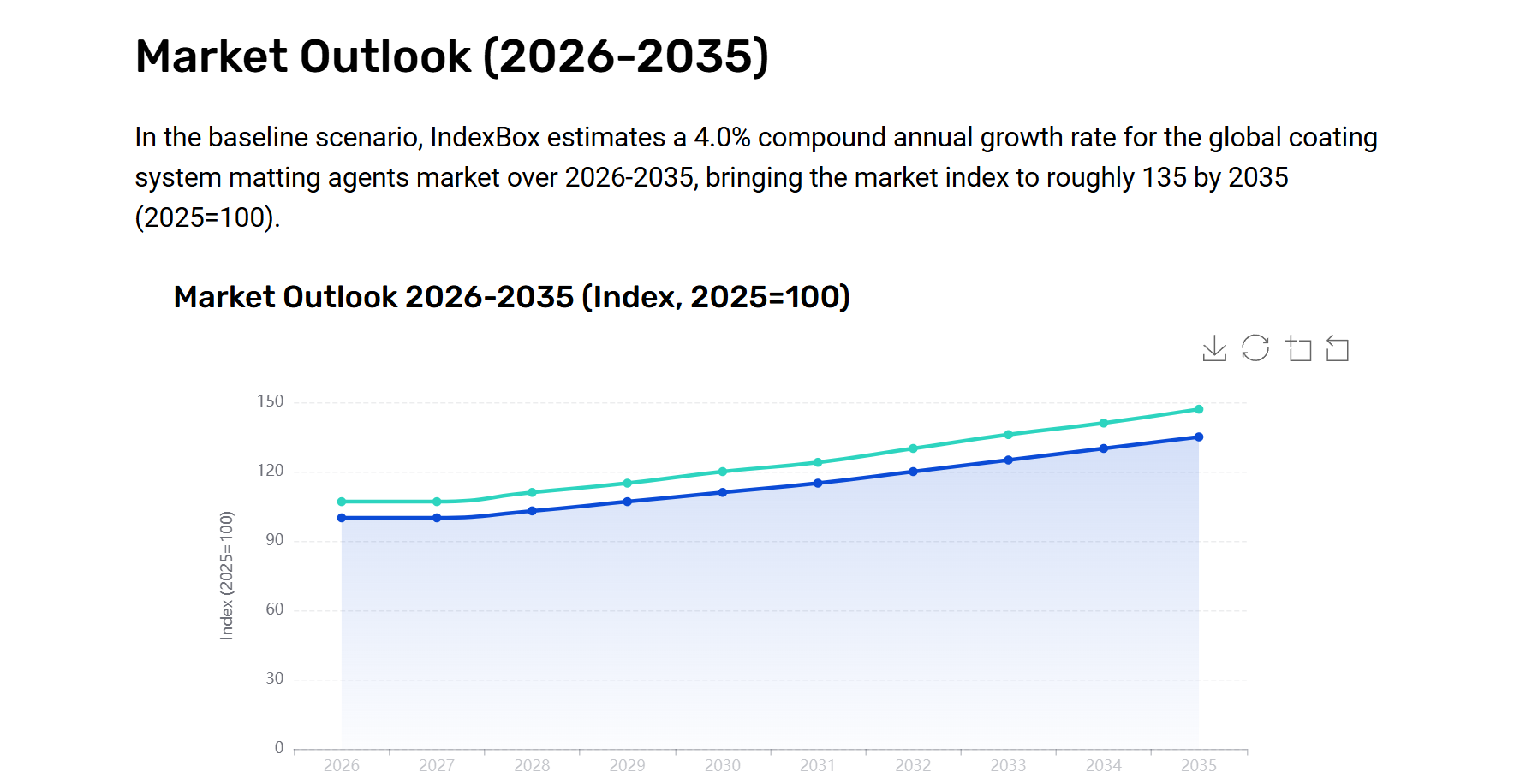
Functional grades will remain the largest segment by volume, but high-purity and specialty grades are forecast to grow faster, driven by applications in electronics, automotive clear coats, and UV-curable systems. Supply chains are likely to remain concentrated in Asia and Western Europe, with trade flows continuing to play a critical role. Price levels are expected to be influenced by feedstock costs, especially for fumed silica and synthetic waxes, which have historically shown volatility. The market index, with 2025 as the base year (100), is projected to reach 135 by 2035, reflecting cumulative growth.
Key risks to this outlook include a sharper-than-expected economic slowdown, raw material supply disruptions, and regulatory changes that could alter demand patterns. However, the fundamental drivers of matte finish adoption and performance requirements are robust, supporting a positive long-term trajectory.
Demand Drivers and Constraints
↑ Primary Demand Drivers
- Rising consumer preference for matte and satin finishes in architectural coatings, driven by aesthetic trends and tactile requirements.
- Growth in automotive production, particularly in Asia-Pacific, increasing demand for high-purity matting agents in clear coats and interior finishes.
- Stringent environmental regulations limiting VOC content in coatings, boosting adoption of specialty matting agents compatible with water-borne and UV-curable systems.
- Expansion of the packaging industry, especially in food-contact and premium segments, requiring high-purity matting agents that meet safety standards.
- Technological advancements in matting agent formulations, such as bio-based and low-dust products, enhancing performance and sustainability.
- Increasing industrial coating applications in metal and plastic substrates, supported by infrastructure spending and manufacturing growth.
↓ Potential Growth Constraints
- Volatility in feedstock prices, particularly for fumed silica and synthetic wax intermediates, creating margin pressure and pricing uncertainty.
- Lengthy supplier qualification timelines (6-12 months) in regulated segments such as automotive and food-contact coatings, hindering market entry and supply flexibility.
- Logistical and documentation compliance challenges for cross-border shipments of silica-based products, including customs reclassifications and tariff changes.
- Availability of substitutes such as flatting extenders and other gloss-reducing additives, which may limit market growth in price-sensitive applications.
- Economic slowdowns in key end-use markets, such as construction and automotive, potentially reducing demand for coatings and associated additives.
Demand Structure by End-Use Industry
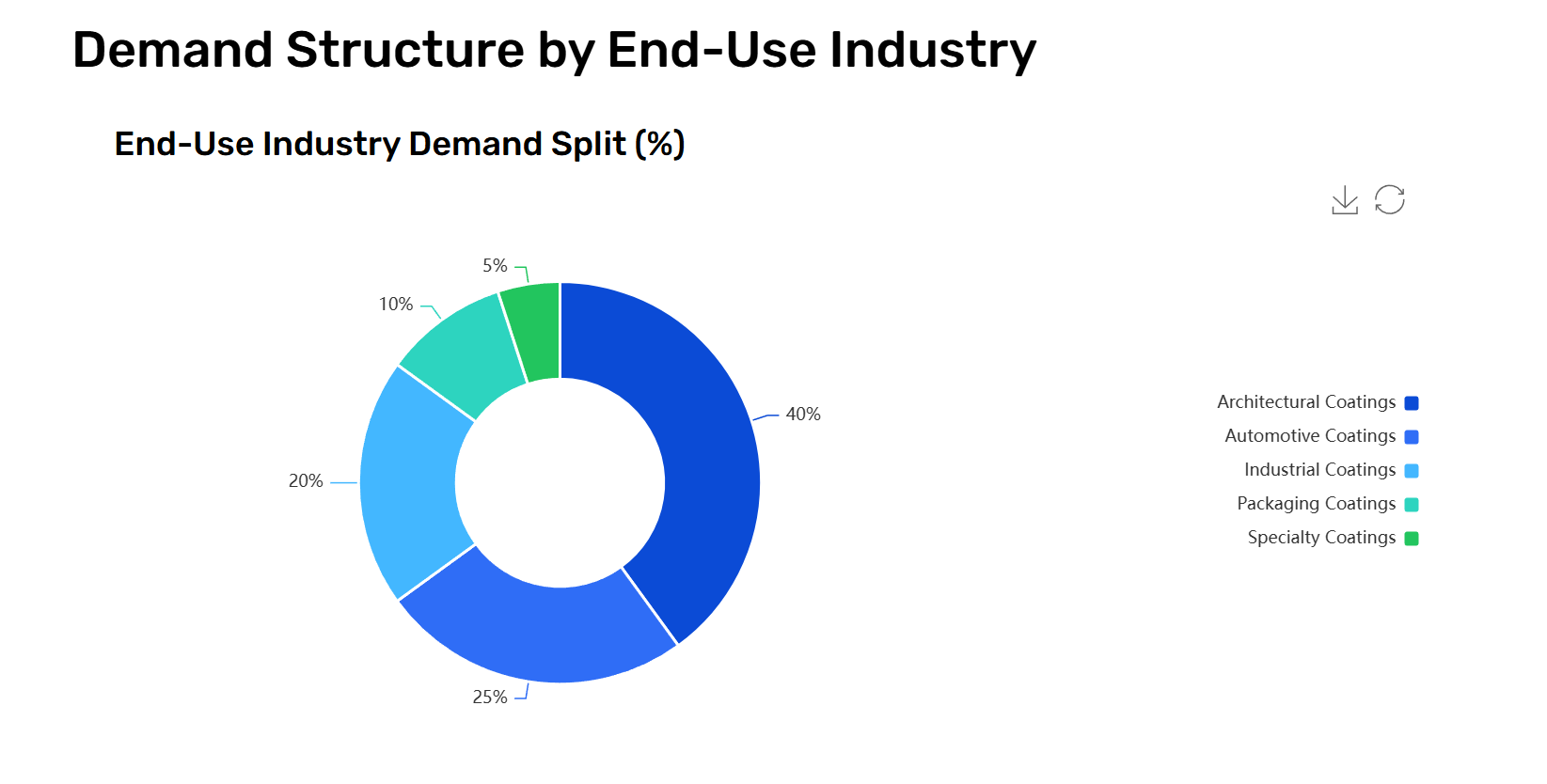
End-Use Industry Demand Split (%)
Architectural Coatings (estimated share: 40%)
Architectural coatings represent the largest end-use sector for coating system matting agents, accounting for an estimated 40% of global demand. This segment is driven by residential and commercial construction, renovation activities, and consumer preferences for aesthetic finishes.
Major trends: Increasing demand for low-VOC and water-borne architectural coatings, Growing preference for matte and satin finishes in interior and exterior applications.
Representative participants: PPG Industries, AkzoNobel, Sherwin-Williams, Asian Paints, and Nippon Paint.
Automotive Coatings (estimated share: 25%)
Automotive coatings are a significant end-use sector for matting agents, representing approximately 25% of global demand. The automotive industry's shift toward electric vehicles (EVs) and premium finishes is driving demand for high-purity matting agents.
Major trends: Rising popularity of matte finishes in premium and electric vehicles, Increasing demand for high-purity matting agents for clear coats.
Representative participants: PPG Industries, BASF, Axalta Coating Systems, Kansai Paint, and Nippon Paint.
Industrial Coatings (estimated share: 20%)
Industrial coatings account for an estimated 20% of global matting agent demand. This segment includes coatings for machinery, equipment, pipes, and other industrial applications where matte finishes are often required for functional reasons.
Major trends: Growing adoption of powder coatings and UV-curable systems, Infrastructure spending and industrial growth in emerging markets.
Representative participants: AkzoNobel, PPG Industries, Sherwin-Williams, RPM International, and Axalta Coating Systems.
Packaging Coatings (estimated share: 10%)
Packaging coatings represent around 10% of global matting agent demand. High-purity matting agents are essential to meet food-contact regulations and ensure no migration of harmful substances.
Major trends: Increasing demand for high-purity matting agents for food-contact applications, Growth in premium and sustainable packaging.
Representative participants: PPG Industries, AkzoNobel, Sherwin-Williams, Evonik Industries, and W.R. Grace & Co.
Specialty Coatings (estimated share: 5%)
Specialty coatings account for approximately 5% of global matting agent demand. This segment includes coatings for electronics, optical films, medical devices, and other high-performance applications.
Major trends: Growing demand for anti-glare and scratch-resistant coatings in electronics, Increasing use of matting agents in optical films.
Representative participants: Evonik Industries, BYK Additives & Instruments, Michelman, Arkema, and Cabot Corporation.
Key Market Participants
Interactive table based on the Store Companies dataset for this report.
| # | Company | Headquarters | Focus | Scale | Note |
|---|---|---|---|---|---|
| 1 | Evonik Industries AG | Essen, Germany | Silica-based matting agents for coatings | Large global chemical producer | Market leader with Acematt and Sipernat brands |
| 2 | W.R. Grace & Co. | Columbia, Maryland, USA | Silica matting agents for industrial coatings | Large multinational | Key player with Syloid brand |
| 3 | PPG Industries, Inc. | Pittsburgh, Pennsylvania, USA | Coatings and matting agent formulations | Large global coatings manufacturer | Integrated producer and user of matting agents |
| 4 | Akzo Nobel N.V. | Amsterdam, Netherlands | Decorative and performance coatings with matting agents | Large multinational | Major coatings producer using matting agents |
| 5 | BASF SE | Ludwigshafen, Germany | Chemical additives including matting agents | Largest chemical company globally | Supplies matting agents for various coating systems |
| 6 | Huntsman Corporation | The Woodlands, Texas, USA | Performance products including matting agents | Large global chemical company | Offers silica-based matting solutions |
Regional Dynamics
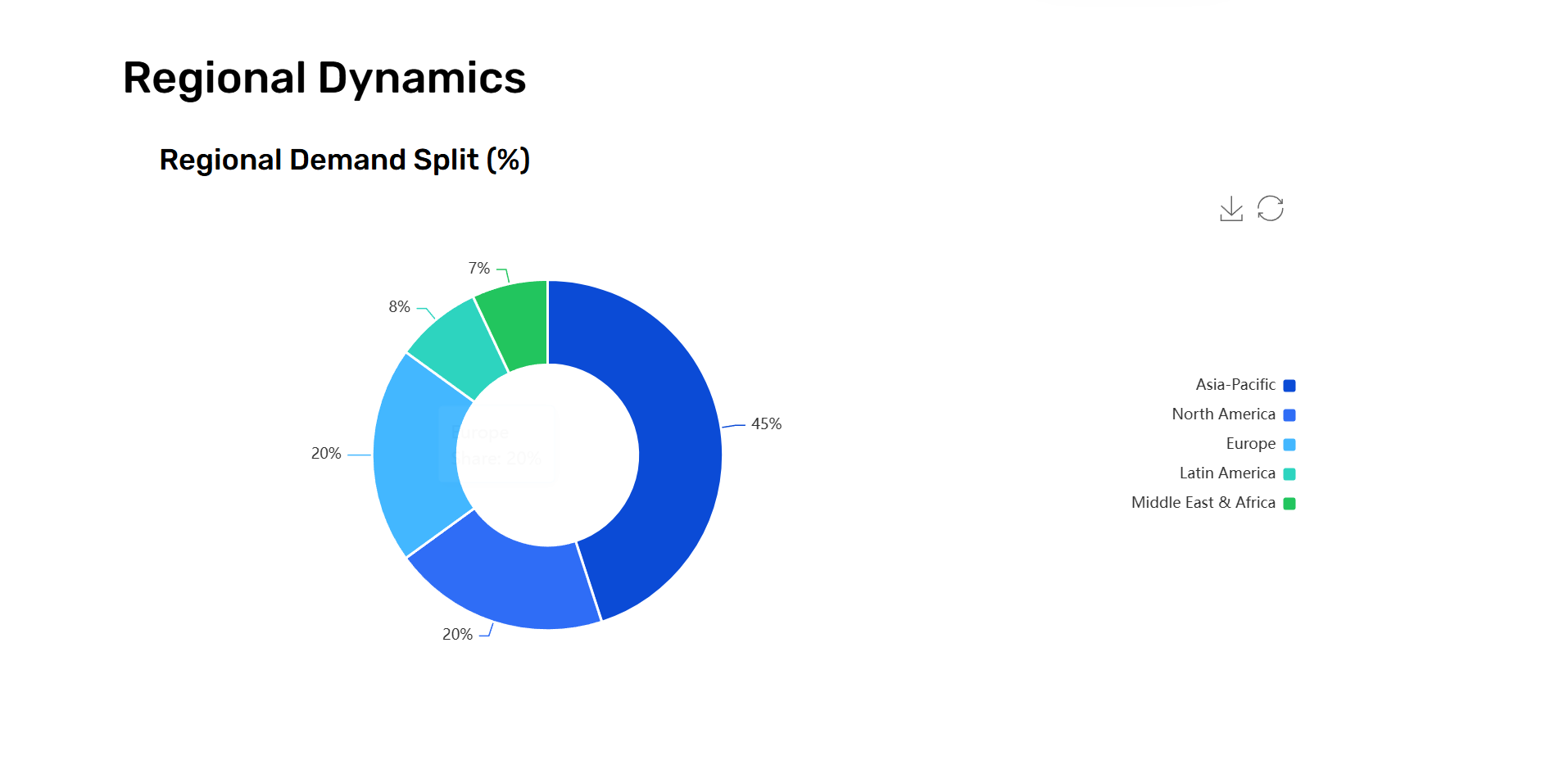
Regional Demand Split (%)
Asia-Pacific 45%
Dominates the market, driven by robust coatings production in China and India. Direction: Growing.
North America 20%
Mature market with a shift toward high-performance and sustainable agents. Direction: Stable.
Europe 20%
Strong focus on low-VOC and bio-based formulations influenced by REACH. Direction: Stable.
Latin America 8%
Emerging market driven by Brazil and Mexico construction sectors. Direction: Growing.
Middle East & Africa 7%
Growing market supported by infrastructure development in GCC. Direction: Growing.
Market Outlook (2026-2035)
In the baseline scenario, IndexBox estimates a 4.0% compound annual growth rate for the global coating system matting agents market over 2026-2035, bringing the market index to roughly 135 by 2035 (2025=100).
Market Outlook 2026-2035 (Index, 2025=100)
Post time: Oct-23-2026


