

According to the latest IndexBox report on the global Leveling Agents High-Gloss Coatings market, themarket enters 2026 with broader demand fundamentals, more disciplined procurement behavior, and amore regionally diversified supply architecture.
The World Leveling Agents High-Gloss Coatings market is projected to expand at a compound annualgrowth rate of 4-6% from 2026 to 2035, supported by replacement procurement cycles, rising qualityspecifications in premium paints, and capacity additions in Asia-Pacific. Premium and high-purity gradescurrently account for roughly one-third of total volume but contribute over half of market value, reflecting astructural shift toward higher-performance formulations that eliminate brush marks and surfaceirregularities in architectural, automotive, and industrial high-gloss coatings. Supply chains remain exposedto feedstock cost volatility-particularly silicones and acrylic polymers-while supplier qualification cyclesof 6-12 months constrain rapid scaling and buyer flexibility, especially in regulated end-use sectorsDemand is migrating toward waterborne and low-VOC high-gloss systems, pushing formulators to developleveling agents that perform in aqueous environments without sacrificing gloss or flow uniformity.Regional production capacity is increasing in China and India, gradually reducing import dependence forstandard functional grades even as high-purity and specialty grades remain largely sourced fromestablished European and North American manufacturers. Digital procurement platforms and directbuyer-supplier collaboration are shortening specification and qualification timelines, but technicalvalidation remains a multi-step workflow that limits rapid vendor switching. Raw material input costs forsilicones, wax emulsions, and polymeric surfactants have fluctuated by +15-25% year-on-year since 2021,creating margin pressure for contract-priced volume agreements and complicating long-term pricingcommitments. Regulatory divergence-VOC limits in the EU, EPA stand
The baseline scenario for the Leveling Agents High-Gloss Coatings market from 2026 to 2035 assumessteady global GDP growth of 2.5-3.0%, moderate industrial production expansion, and continuedurbanization in emerging economies. Under this scenario, demand for high-gloss coatings in architectural,automotive, and industrial applications will grow at a CAGR of 4-6%, with the market index reaching 150-180 by 2035 (2025=100). The shift toward waterborne and UV-curable systems will accelerate, driven bytightening environmental regulations and consumer preference for low-VOC products. Premium and high-purity grades will outperform standard functional grades, capturing a larger share of value as end-usersprioritize gloss retention, surface uniformity, and defect reduction. Asia-Pacific will remain the largest andfastest-growing region, supported by expanding construction activity, automotive production, andindustrial output in China, India, and Southeast Asia. North America and Europe will see moderate growthwith demand driven by replacement cycles, renovation activity, and regulatory compliance. Latin Americaand Middle East & Africa will grow at a slower pace, constrained by economic volatility and lower industrialdiversification. Supply-side dynamics will be shaped by feedstock cost fluctuations, capacity expansions inAsia, and ongoing consolidation among coating OEMs. Pricing pressure on standard grades will persist,while premium segments will support higher margins. Trade flows will evolve as regional productioncapacity increases, reducing import dependence for standard grades but maintaining reliance on specialtyimports from established manufacturers. Overall, the market is set for sustained growth, withopportunities for innovation in waterborne and high-per
Demand Drivers and Constraints
Primary Demand Drivers
· Rising demand for high-gloss architectural paints in residential and commercial construction
· Stringent environmental regulations pushing adoption of waterborne and low-VOC formulations
· Growing automotive production and refinish demand for premium topcoats
Increasing consumer preference for defect-free, high-gloss finishes in furniture and wood coatings
· Expansion of industrial coatings applications in coil, can, and powder coatings Technological advancements in UV-curable and high-solids coating systems
Potential Growth Constraints
· Volatility in raw material prices for silicones, acrylic polymers, and wax emulsions
· Lengthy supplier qualification cycles (6-12 months) in regulated end-use sectors
· Regulatory divergence across regions increasing formulation and certification costs
· Buyer consolidation among paint and coating OEMs intensifying price competition for standard grades
· Substitution risk from alternative surface-smoothing technologies or in-house formulations
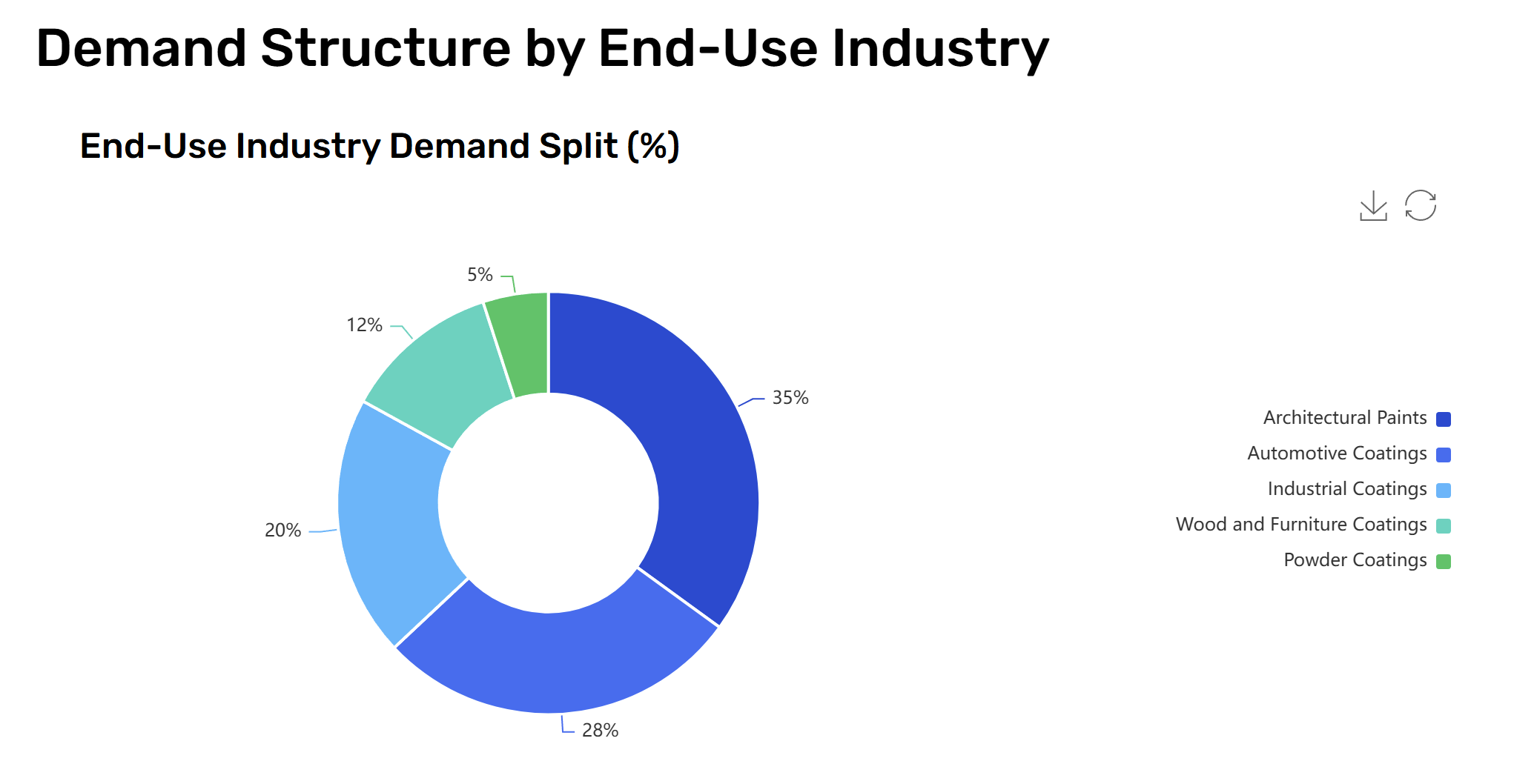
Automotive Coatings (estimated share: 28%)
Automotive coatings represent 28% of the leveling agents market, driven by OEM production andaftermarket refinish applications. High-gloss topcoats require high-purity leveling agents to achievesuperior surface smoothness, gloss retention, and defect reduction. The segment is characterized bystringent quality specifications and long qualification cycles. Demand is linked to global vehicle production,which is expected to grow at 2-3% annually through 2035, with electric vehicle production driving newcoating requirements. Waterborne and UV-curable systems are gaining traction, particularly in Europe andNorth America, to meet environmental regulations. High-purity grades command premium pricing and aresourced from established manufacturers like BYK-Chemie and Momentive. Key demand-side indicatorsinclude automotive production volumes, refinish market activity, and regulatory timelines. By 2035,premium grades are expected to account for over 40% of automotive leveling agent demand, up from 30%in 2025. Current trend: Moderate growth supported by OEM production and refinish demand, with premiumhigh-purity grades gaining share.
Major trends: Adoption of waterborne and UV-curable topcoats in OEM and refinish, Increasing demand forhigh-purity grades to meet gloss and defect standards, and Growth in electric vehicle production drivingnew coating specifications.
Representative participants: BYK-Chemie GmbH (Altana AG), Momentive Performance Materials Inc, BASFSE, PPG Industries Inc, Axalta Coating Systems Ltd, and Nippon Paint Holdings Co., Ltd.
Industrial Coatings (estimated share: 20%)
Industrial coatings account for 20% of leveling agent demand, encompassing coil coatings, can coatings,and general industrial applications. These segments require leveling agents that provide high gloss,excellent flow, and resistance to mechanical and chemical stress. Demand is tied to industrial productionindices, construction of metal buildings, and packaging consumption. Coil coatings for pre-painted metalsheets are a major application, with growth driven by construction and appliance manufacturing. Cancoatings for food and beverage packaging require high-purity grades to ensure safety and performanceThe trend toward waterborne and high-solids systems is evident, though solvent-borne formulationsremain prevalent in certain applications. Key demand-side indicators include industrial output, metalconstruction activity, and packaging demand. By 2035, waterborne and high-solids formulations areexpected to represent 50% of industrial high-gloss coatings, up from 35% in 2025. Major suppliers includeEastman, Arkema, and Elementis. Current trend: Steady expansion driven by coil, can, and generalindustrial applications, with focus on durability and gloss.
Major trends: Growth in coil coatings for construction and appliance sectors, Shift toward waterborne andhigh-solids formulations, and Increasing demand for high-purity grades in can coatings.
Representative participants: Eastman Chemical Company, Arkema S.A, Elementis plc, BASF SE, PPGIndustries Inc, and Akzo Nobel N.V.
Post time: Jun-26-2026


