

UV-curable organosilicon oligomers are polymers whose main chain consists of repeating Si—O bonds in polysiloxane, and they contain reactive groups that can undergo polymerization and crosslinking, such as acryloyloxy, vinyl, or epoxy groups. In current UV-curing applications, the main type is organosilicon acrylate oligomers containing acryloyloxy groups.
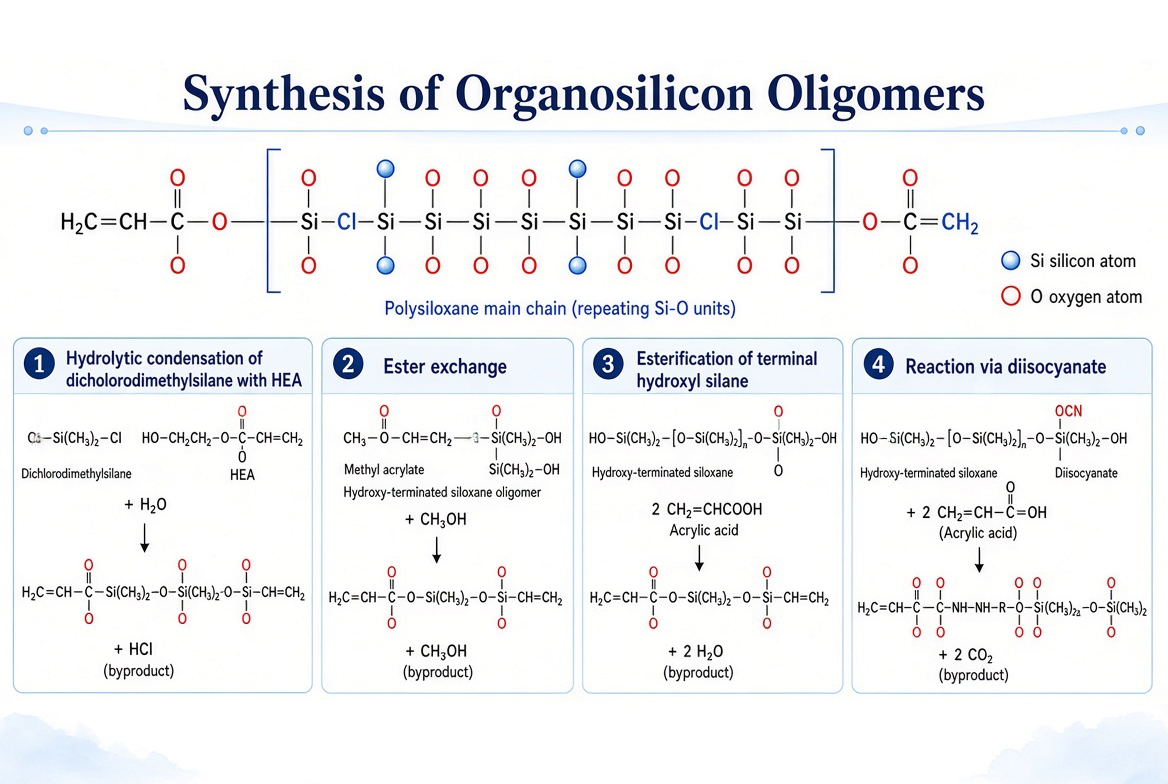
There are mainly the following methods for introducing acryloyloxy groups into polysiloxane:
① Hydrolytic condensation of dichlorodimethylsilane monomer and hydroxyethyl acrylate (HEA) under base catalysis, in which HEA is introduced as an end group onto the polysiloxane chain.

① Introduction of acryloyloxy groups via ester exchange reaction between diethoxysilane and hydroxyethyl acrylate.

① Introduction of acryloyloxy groups by esterification of terminal hydroxyl-containing silane with acrylic acid.

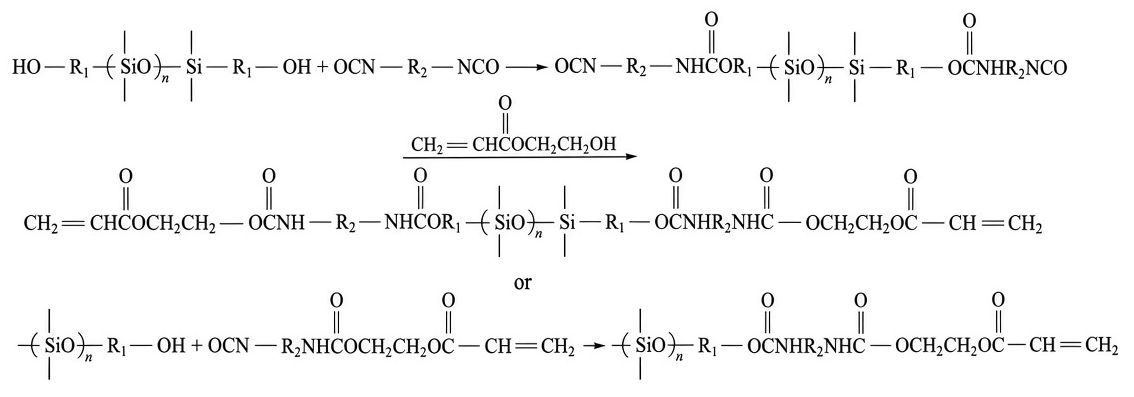
① Reaction of terminal hydroxyl-containing silane with diisocyanate, followed by reaction with hydroxyethyl acrylate; or reaction of terminal hydroxyl-containing silane with a diisocyanate-hydroxyethyl acrylate half-adduct, to introduce acryloyloxy groups.
Properties and Applications of Organosilicon Oligomers
Organosilicon acrylates are oligomers with special properties. They have relatively low surface tension and can therefore be used as release agents in release paper for pressure-sensitive adhesives, coated on paper or plastic films. After curing, they form a surface with very low adhesion, which can be combined with pressure-sensitive adhesive materials to produce auxiliary materials for self-adhesive labels, diapers, and sanitary napkins. The main chain of organosilicon oligomers consists of siloxane bonds, giving them excellent flexibility, low-temperature resistance, moisture resistance, weather resistance, and electrical properties. They are commonly used as protective coatings, such as for the coating protection and sealing of electrical appliances and electronic circuits, and can also be used as optical fiber protective coatings. In addition, they can serve as adhesives for optical devices made of glass and quartz.
Post time: Aug-28-2026


