

The synthesis methods for acrylate reactive diluents primarily include direct esterification, transesterification, acid chloride method, phase-transfer catalysis, and addition esterification. However, the majority are produced via direct esterification.
(1) Direct Esterification
CH₂=CHCOOH + ROH -catalyst→ CH₂=CHCOOR + H₂O
Commonly used catalysts for direct esterification include concentrated sulfuric acid, p-toluenesulfonic acid, and methanesulfonic acid. Using concentrated sulfuric acid as an esterification catalyst often triggers side reactions such as dehydration, oxidation, and self-esterification of the reactants. This generates various by-products, complicates product purification and raw material recovery, disrupts post-treatment processes, and compromises product quality while corroding equipment. Consequently, PTSA is predominantly used in current industrial production due to its advantages, including low dosage requirements, low reaction temperatures, high conversion rates, and superior product quality. Upon reaction completion, the catalyst can be easily separated from the product, simplifying the process workflow. The water generated during the esterification reaction is removed using an azeotropic entrainer (dehydrating agent). Common entrainers include benzene, toluene, xylene, cyclohexane, and n-heptane, which form azeotropes with the reaction water to carry it away. Alkanes are expensive and highly volatile; xylene possesses a high boiling point; benzene has a relatively low boiling point and high volatility, making it difficult to recover, and it exhibits high toxicity. Therefore, toluene is generally preferred as the entrainer. Toluene has a boiling point of 110°C and a water-toluene azeotropic boiling point of 84°C; it condenses easily during vacuum distillation solvent stripping, ensuring a high recovery rate, lower toxicity than benzene, and a relatively economical cost. However, in recent years, regulatory restrictions on benzene-series solvents in coatings, inks, and adhesives have prompted many manufacturers to phase out toluene in favor of alkane-based entrainers. Polymerization inhibitors must be introduced during the esterification process to prevent the premature polymerization of the acrylic acid monomer and the resulting acrylate product. Commonly utilized inhibitors include phenolic compounds (such as hydroquinone [HQ] and tert-butylhydroquinone [TBHQ]), amine compounds (such as phenothiazine and p-phenylenediamine), and copper coordination complexes (such as copper dimethyldiethyldithiocarbamate and copper dibutyl dithiocarbamate), applied either individually or as a blended formulation. For higher alkyl acrylates, melt esterification can be employed. This method eliminates the need for an entrainer and reduces the required dosage of catalysts and inhibitors. Following a reflux reaction at 110–120°C, dehydration is performed, and unreacted acrylic acid and residual water are ultimately stripped via vacuum distillation, yielding higher alkyl acrylates with high purity and high yields.
(2) Transesterification
CH₂=CHCOOCH₃ + ROH → CH₂=CHCOOR + CH₃OH
When preparing higher alkyl acrylates or functional acrylates via transesterification, methyl acrylate is typically chosen as the lower alkyl ester starting material. Due to its low boiling point (80°C), the esterification must be conducted at lower temperatures, which prolongs the reaction time. Furthermore, the by-product methanol forms an azeotrope with methyl acrylate (boiling point 62–63°C), which carries away the reactant methyl acrylate and consequently lowers the yield of the target higher ester. Methyl acrylate and higher acrylates are highly prone to copolymerization and homopolymerization, further decreasing the yield of the higher acrylates; thus, increased dosages of inhibitors are frequently required. Due to cost considerations and post-treatment complexities, this method is no longer utilized commercially for the synthesis of higher alkyl acrylates and functional acrylates.
(3) Acid Chloride Method
CH₂=CHCOOH + SOCl₂ → CH₂=CHCOCl + HCl + CO₂
CH₂=CHCOCl + ROH → CH₂=CHCOOR + HCl
This method first reacts acrylic acid with thionyl chloride to synthesize acryloyl chloride, which then undergoes an esterification reaction with an alcohol. It requires no catalysts or entrainers. Because the reaction proceeds at low temperatures, the addition of polymerization inhibitors is also avoided. The esterification proceeds almost quantitatively, yielding exceptional product purity. However, it is a two-step process with high production costs. The reaction generates substantial volumes of HCl and SO₂ gases, requiring multi-stage scrubbing systems with dilute alkaline solutions and water for absorption.
(4) Phase-Transfer Catalysis (PTC)
2CH₂=CH₃|C-COOH + Na₂CO₃ → 2CH₂=CH₃|C-COONa + CO₂ + H₂O
CH₂=CH₃|C-COONa + ClCH₂-CH₂O → CH₂=CH₃|C-COOCH₂-CH₂O + NaCl
Sodium methacrylate exists as a solid, whereas epichlorohydrin is a liquid. In the absence of a catalyst, the reaction between them is highly sluggish, necessitating the use of a phase-transfer catalyst (PTC). Suitable phase-transfer catalysts include quaternary ammonium salts, quaternary phosphonium salts, and crown ethers. Quaternary ammonium salts are the most prevalent, such as cetyltrimethylammonium chloride (CTAC), benzyltrimethylammonium chloride (BTMAC), and tetramethylammonium chloride (TMAC). The presence of moisture in the reaction system triggers side reactions; therefore, to optimize yield, both the raw materials and the reaction system must be kept strictly anhydrous and dry.
(5) Addition Esterification
CH₂=R₁|C-COOH + CH₂-CH₂O-R₂ → CH₂=R₁|C-COO-CH₂-OH|CH₂-R₂
By introducing ethylene oxide or propylene oxide directly into (meth)acrylic acid in the presence of a catalyst, a ring-opening addition esterification occurs, synthesizing hydroxy (meth)acrylates (such as HEA, HEMA, HPA, or HPMA). 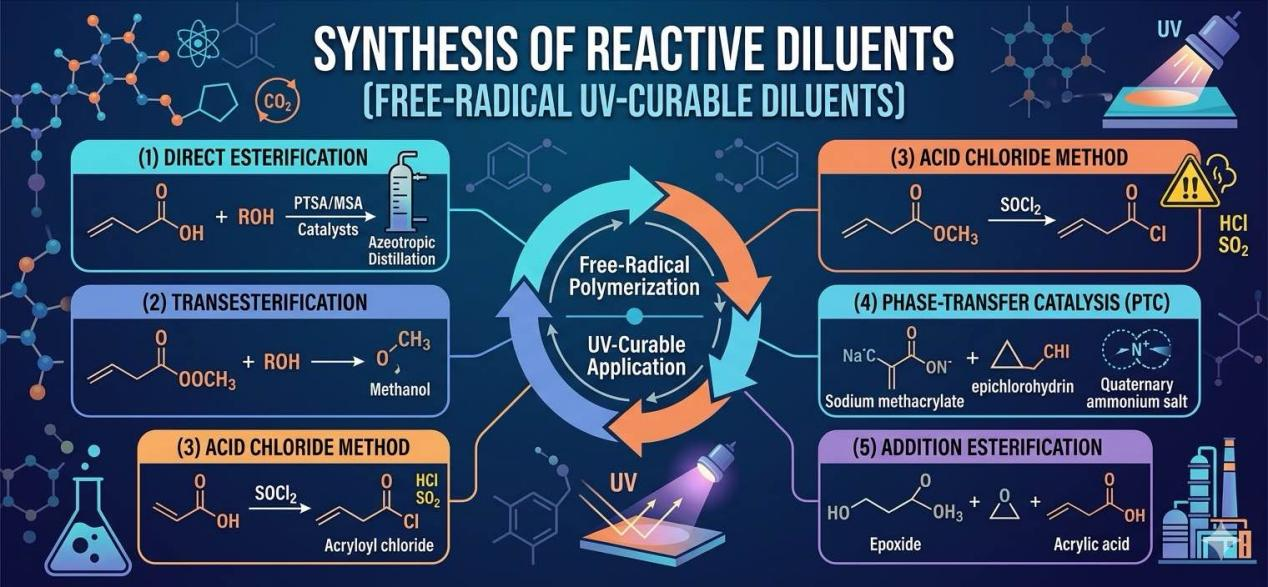
Post time: Jun-10-2026


