

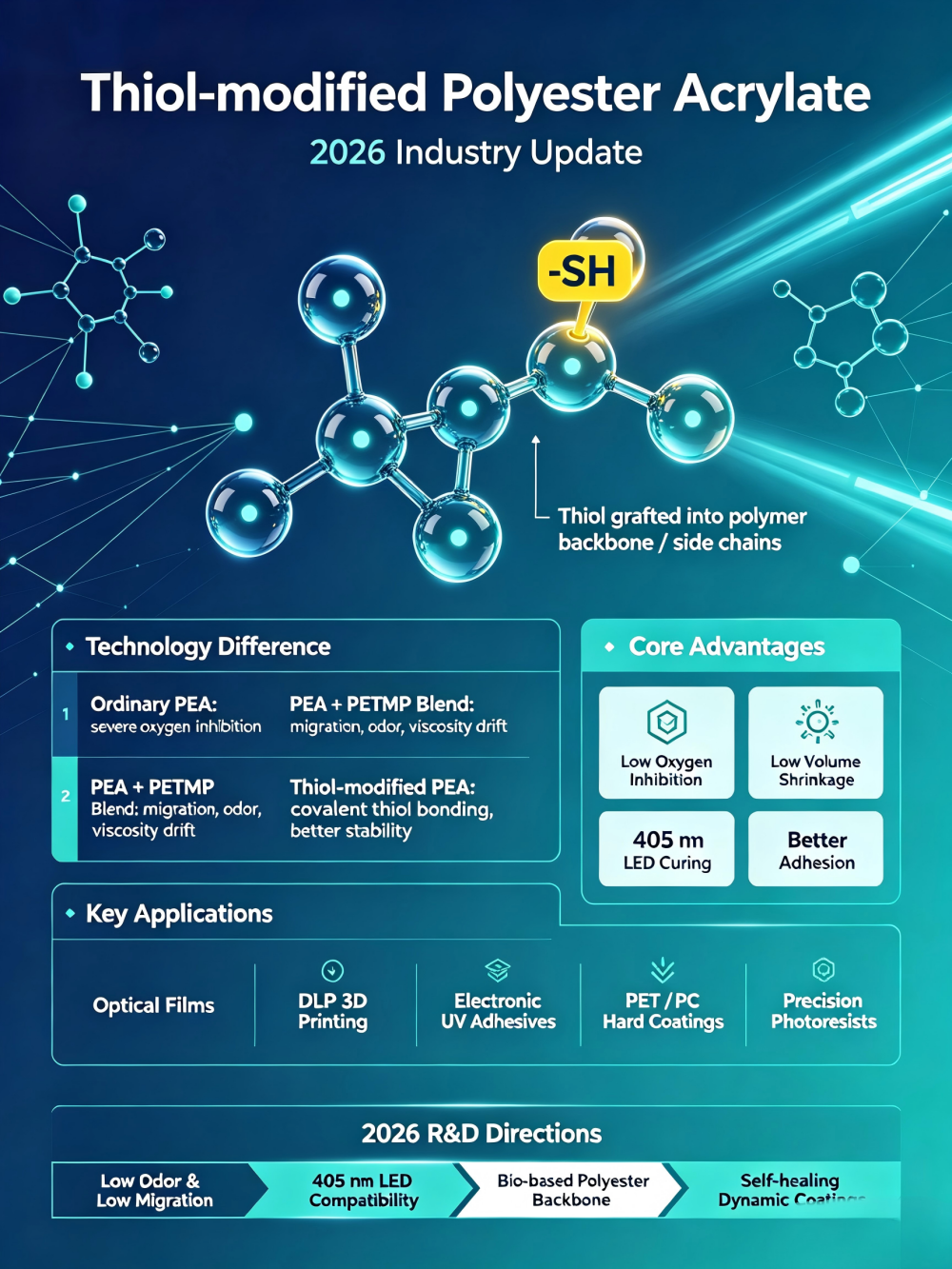
Abbreviated as thiol-modified PEA. Different from simple blends of conventional PEA plus external thiol monomers, it is a polyester acrylate oligomer with thiol groups (-SH) directly introduced into the molecular backbone or side chains, belonging to the thiol-ene click UV curing system. Core advantages: strong inhibition of oxygen inhibition, low volume shrinkage, good curing performance under LED-UV (405 nm), improved adhesion. It has become a high-end niche segment of photo-curable oligomers in recent years.
I. Market Updates
Positioning: High-end niche oligomer with high added value Conventional PEA follows free-radical curing, suffering from severe oxygen inhibition, sticky surface after curing and relatively high shrinkage. For thiol-modified PEA, thiol groups are chemically bonded into the resin molecule, instead of simply blending with thiol monomers such as PETMP. It delivers better compatibility and superior storage stability compared with blended systems. Its current market volume is much smaller than general-purpose PEA, yet it commands a substantial premium. Downstream applications are mainly optical films, 3D printing, electronic UV adhesives, hard coatings on PET/PC substrates, and precision photoresists.
Demand driver: Popularization of LED-UV production lines LED light sources feature low energy output and prominent oxygen inhibition issues. Conventional PEA often fails to achieve surface dryness. Thiol-modified PEA has become a preferred option for formulators to tackle sticky surfaces under 405 nm LED curing. In 2026, inquiries for this resin have risen notably from optical display, high-precision DLP 3D printing and flexible electronic coating sectors.
Competitive landscape Domestic: Multiple photo-curable resin manufacturers and university laboratories are carrying out relevant R&D. Most projects remain at the pilot stage, with only a limited number of industrialized commercial grades available. It serves as a differentiated breakthrough for domestic UV oligomer businesses.
II. Technology & Patent News in 2026
Domestic University Patent (Mar 2026, Qingdao University of Science and Technology)
LED photo-curable composition containing thiol-modified polyester acrylate. Under 405 nm LED irradiation, it achieves full surface curing with shrinkage controlled below 2.2% and greatly enhanced interlayer strength, targeting high-precision 3D printing. The core design is grafting thiol groups onto side chains of polyester acrylate, which mitigates migration, odor and blooming issues caused by small-molecule thiols (Patent No. CN121628010A). Problem solved: Traditional small-molecule thiol monomers tend to migrate, generate strong odor and cause viscosity drift during long-term storage. Covalently bonded thiol groups in resins suppress migration.
Overseas R&D Progress (RSC, H1 2026)
Research on bio-based thiol-modified polyester acrylate: Castor oil-based polyester backbone grafted with thiol groups yields self-healing photo-curable resins for 3D printing of flexible devices. Dynamic covalent thiol bonds enable microcrack self-repair of coatings. Drawbacks include low Tg and limited scratch resistance; the material stays in laboratory development.
III. Industry Pain Points & Trends
Core Commercialization Bottlenecks
1. Thiol groups are prone to oxidation, making the resin harder to stabilize in storage than ordinary PEA; oxygen scavenger stabilizers are required.
2. High cost of thiol raw materials, resulting in a selling price far above conventional polyester acrylates.
3. Odor control: Even with macromolecular grafting, faint thiol odor persists, restricting its use in premium food-contact scenarios.
4. Challenging synthesis process: The thiol grafting ratio must be precisely controlled. Excessively high grafting impairs storage stability, while insufficient grafting delivers limited improvement against oxygen inhibition.
Main R&D Directions in 2026
① Low-odor, low-migration thiol-modified PEA to replace simple PEA+PETMP blends ② Formulations compatible with 405 nm LED curing for optical films and 3C hard coatings ③ Bio-based polyester backbone with thiol modification to meet carbon footprint and REACH compliance requirements ④ Dynamic self-repairable coatings: Utilizing reversible thiol-disulfide crosslinking for recoverable protective films
Post time: Sep-11-2026


